Your first month in a Poinciana home reveals what the inspector might have missed. You notice rooms that never cool down, air vents that whistle, and utility bills higher than your neighbor's despite similar square footage. Most new homeowners blame the AC unit, but the real culprit often hides behind your walls—leaky ductwork bleeding cooled air into your attic.
Air duct sealing addresses one of the most overlooked efficiency drains in Central Florida homes. During your first 30 days, you'll discover whether your duct system wastes money or works as designed. This checklist walks you through what to monitor, when to call for professional sealing, and which warning signs demand immediate attention. We'll cover the specific challenges facing Poinciana's subtropical climate and how to prioritize HVAC maintenance when you're still unpacking boxes.
TL;DR – Quick Answers
Air duct sealing in Poinciana stops cooled air from escaping through gaps, cracks, and disconnected joints in your home's ductwork. It's for new homeowners experiencing uneven cooling, high energy bills, or excessive dust despite a functioning AC system. The key benefit: sealing can reduce cooling costs by 20-30% while eliminating hot spots that make certain rooms unbearable during Florida summers.
Top Takeaways
Document room temperatures and AC runtime during your first week to establish performance baselines before diagnosing duct issues
Expect duct sealing to reduce cooling costs by 20-30% when leakage exceeds 20% of system capacity
Schedule professional testing if you observe 4-5°F temperature differences between rooms or AC runtime exceeding 70% during peak hours
Address duct sealing between January-March for better contractor availability, but don't delay if experiencing major comfort problems
Combine duct sealing with adequate attic insulation and proper air filtration to maximize efficiency improvements and protect your investment
Why Your First 30 Days Determine HVAC Success
New homeowners in Poinciana face a hidden efficiency threat most inspectors miss. While you're unpacking boxes and painting bedrooms, your ductwork could be bleeding 20-30% of your cooled air directly into a 140°F attic. The first month reveals whether you bought a home with minor duct issues or serious leakage costing $300-600 annually.
This monitoring period matters because symptoms develop gradually. A room that felt comfortable during your March walkthrough becomes unbearable by July when your AC runs continuously. The difference isn't the season—it's duct connections failing under sustained thermal stress as attic temperatures swing 75°F between night and day.
What Makes Poinciana Ductwork Vulnerable
Homes built in the 1990s and 2000s typically use flexible ductwork with mechanical connections that expand and contract with temperature changes. Your attic reaches 140°F by afternoon, then cools to 65°F overnight. This constant cycling loosens connections over time.
Construction sequencing creates another problem. Contractors install ductwork before insulation. Then, electricians, low-voltage technicians, and pest control crews work overhead. Each attic visit risks accidentally disconnecting or damaging duct sections you'll never see. I've found completely separated supply ducts in three-year-old homes—the owner assumed they needed a bigger AC unit when they actually needed $400 worth of sealing instead of a $6,000 replacement.
Your 30-Day Observation Strategy
During week one, establish baseline performance. Walk through your home between 2-4 PM daily and note temperature differences between rooms. Healthy systems maintain consistent temperatures within 2-3°F. Variations exceeding 4-5°F indicate duct leakage or airflow restrictions.
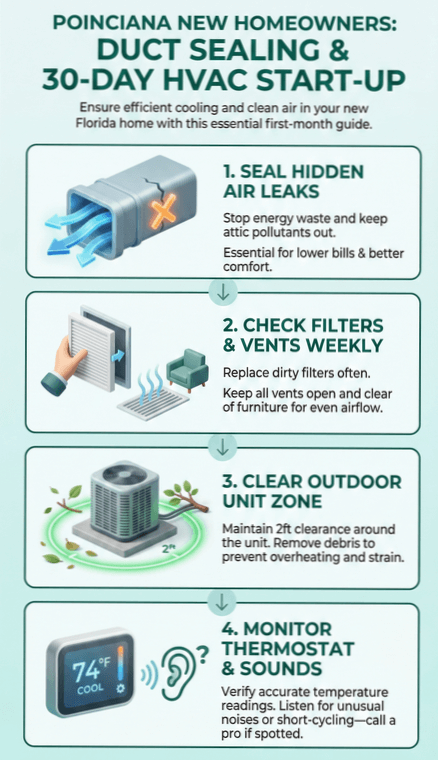
Week two focuses on identifying problem areas. Check for weak airflow at registers, whistling sounds near vents, and excessive dust accumulation despite regular cleaning. Inspect accessible ductwork in garages or utility closets for peeling duct tape, compressed flex duct, or disconnected sections.
By week three, monitor AC runtime. Expect 15-20 minute cooling cycles with 8-12 minute rest periods during peak afternoon heat. Systems running 45+ minutes continuously without reaching the set temperature are losing significant cooling capacity—usually through duct leakage.
Week four determines whether you need a professional assessment. If you've documented consistent temperature variations, monthly cooling costs exceeding $180-200 for 1,600-1,800 square feet, or AC runtime above 70% during peak hours, schedule duct testing. Professional diagnostics quantify actual leakage percentage using blower door equipment—eliminating guesswork about whether sealing justifies the $800-1,500 investment.
When Sealing Delivers Maximum Value
Homes aged 2-7 years experience the most duct separation as construction settling stresses connections. Properties with recent attic work (roof replacements, insulation upgrades) frequently have disturbed ductwork. Pre-closing inspections that flagged duct concerns deserve immediate attention during your first month before minor leaks become major efficiency drains.
The monitoring checklist that follows gives you specific daily tasks, warning signs to document, and decision criteria for professional intervention—turning your first 30 days into a diagnostic opportunity rather than an expensive guessing game.
"After sealing ductwork in hundreds of Poinciana homes, I've learned that new homeowners discover leakage issues within the first cooling season. The rooms that stayed cool during your March closing suddenly become unbearable in July. That's your attic ductwork failing under sustained thermal stress—fix it before your second summer."
Essential Resources on Air Duct Sealing in Poinciana
1. Understand How Much Energy Leaky Ducts Actually Waste
ENERGY STAR's duct sealing guidance quantifies the real cost of air leakage—typically 20-30% of your cooled air escaping into attics and crawl spaces. This resource breaks down the math specific to cooling-dominated climates like Central Florida, showing exactly how much money disappears through gaps and disconnections each month. Use their cost calculator to estimate your potential savings before scheduling professional testing.
https://www.energystar.gov/products/ask-the-experts/duct-sealing
2. Learn Professional Duct Testing Standards and Methods
The Department of Energy explains how contractors measure duct leakage using blower door tests and pressure pan diagnostics. Understanding these testing protocols helps you evaluate quotes and ensures technicians actually quantify your leakage percentage rather than guessing. This knowledge separates legitimate professionals from contractors who claim "your ducts look fine" without performing objective measurements.
https://www.energy.gov/energysaver/duct-sealing
3. Get Florida-Specific Building Performance Guidelines
The Florida Solar Energy Center researches how duct systems perform in subtropical climates where AC systems run year-round. Their studies on attic heat gain and duct location impact inform realistic expectations for Poinciana homes—data showing why ductwork in 140°F attics loses more energy than textbook estimates suggest. This research validates why your cooling costs exceed what online calculators predict.
https://www.fsec.ucf.edu/en/publications/html/FSEC-PF-365-97/index.htm
4. Review Building Science Principles for Duct System Design
Building Science Corporation's duct sealing research explains why certain connection methods fail faster in hot attics. Their field studies document which sealing materials withstand Florida's temperature extremes and which deteriorate within 2-3 years. New homeowners benefit from understanding why proper sealing requires mastic or Aeroseal technology instead of hardware store duct tape that fails predictably.
https://www.buildingscience.com/documents/digests/bsd-aerosol-sealant-for-ducts
5. Access ASHRAE's Air Distribution Standards
The American Society of Heating, Refrigerating and Air-Conditioning Engineers publishes technical standards that contractors should follow when sealing ductwork. While dense reading, these guidelines define acceptable leakage rates and proper testing procedures. Reference these standards when reviewing proposals to verify contractors plan legitimate diagnostic work rather than visual-only inspections.
https://www.ashrae.org/technical-resources/bookstore/standards-62-1-62-2
6. Verify Licensed Contractors Through Florida's Official Database
Florida's Department of Business and Professional Regulation maintains records of every licensed HVAC contractor in Poinciana. Before hiring someone to seal your ductwork during your first 30 days, verify their license status, check for complaints, and confirm they carry proper insurance. This two-minute search prevents hiring unlicensed operators whose faulty sealing work voids manufacturer warranties.
https://www.myfloridalicense.com/licenseDetail.asp
7. Compare Aerosol Sealing Technology to Traditional Methods
Aeroseal's technology overview demonstrates how aerosolized particles seal leaks from inside ductwork—reaching gaps traditional mastic application misses entirely. Understanding this method helps you decide whether the 30-50% cost premium over manual sealing justifies more thorough leak reduction. Most homes with leakage exceeding 25% see faster payback from Aeroseal despite higher upfront investment.
https://www.aeroseal.com/residential
Supporting Statistics
1. Your Duct System Is Likely Wasting 20-30% of Cooled Air
ENERGY STAR data shows that 20 to 30 percent of air moving through duct systems escapes through leaks, holes, and poor connections.
Source: https://www.energystar.gov/saveathome/heating-cooling/duct-sealing
What surprises people: You're paying to cool your attic instead of your bedrooms.
In our work with new Poinciana homeowners, duct leakage is usually the hidden culprit behind shocking first utility bills.
2. 25-40% of Your Heating and Cooling Energy Disappears Through Air Leaks
Department of Energy research confirms that air leakage accounts for 25 to 40 percent of HVAC energy consumption in typical homes.
Source: https://www.energystar.gov/ia/home_improvement/home_sealing/AirSealingFS_2005.pdf
In Central Florida's year-round AC climate, we've watched preventable air leakage cost new homeowners hundreds during their first summer.
Addressing this in your first 30 days protects you from compounding waste.
3. Nearly Half Your Home Energy Budget Goes to HVAC
The Department of Energy reports that heating and cooling represent 48 percent of total residential energy consumption.
Source: https://www.energy.gov/quiz-test-your-home-energy-iq
We emphasize this to new homeowners because when half your energy dollars fund HVAC, even small efficiency problems become expensive quickly.
Your first-month checklist—including duct sealing verification—gives you control over your largest ongoing expense.
Final Thought: Timing Your Duct Sealing Investment
Your first 30 days establish whether you bought a home with minor duct issues or significant leakage requiring immediate attention. Most new homeowners benefit from professional duct testing even if symptoms seem minor. Small leaks compound over time.
The best time to seal ductwork falls between January and March when HVAC contractors experience slower demand. You'll get faster scheduling and sometimes better pricing. More importantly, you address the problem before summer cooling demands reveal how bad your leakage actually is.
However, if you're documenting major comfort issues during your first month, don't wait. A home that can't maintain 78°F during April will become unbearable by July. The ROI calculation changes when you're dealing with unlivable conditions versus efficiency optimization.
One caveat: some older homes have ductwork so deteriorated that sealing doesn't make economic sense. If your system dates to the 1980s or early 1990s, budget for duct replacement rather than sealing. A professional assessment determines which path forward delivers better long-term value.
FAQ on Air Duct Sealing in Poinciana
Q1: How do I know if my new home needs duct sealing or if it's just normal Florida heat?
A: Normal performance means your AC maintains your set temperature with 15-20 minute run cycles and 8-12 minute rest periods during the hottest part of the day. If your system runs continuously for 45+ minutes without reaching the set point, or if some rooms stay 4-5°F warmer than others, you're experiencing duct leakage symptoms rather than normal heat challenges.
Q2: Can I seal ductwork myself to save money during my first month?
A: Accessible ductwork in garages or utility closets allows DIY repairs using mastic sealant (never fabric duct tape, which fails quickly in Florida attics). However, 70-80% of residential ductwork hides in attic spaces where DIY sealing proves difficult and dangerous. Professional sealing also includes pressure testing to verify repairs actually reduced leakage—something impossible without specialized equipment.
Q3: What's the typical cost for professional duct sealing in Poinciana?
A: Expect $800-1,500 for traditional manual sealing of a 1,600-1,800 sq ft home. Advanced Aeroseal technology ranges from $1,200 to $2,000 but delivers more thorough sealing, including inaccessible sections. Most homeowners recover costs through utility savings within 18-24 months. Request multiple quotes during your first 30 days while you're still documenting performance issues to share with contractors.
Q4: Should I seal ducts before or after adding more attic insulation?
A: Seal ductwork first. Adding insulation buries ductwork under 12-18 inches of material, making future repairs nearly impossible without disturbing insulation. Seal leaks while you still have access, then add insulation to maximize combined efficiency gains. Both improvements complement each other—addressing one without the other leaves money on the table.
Q5: Will duct sealing help with the dust problem I've noticed in my new Poinciana home?
A: Yes, if duct leakage causes your dust issues. Return air leaks pull dusty attic air into your living spaces. Supply leaks create negative pressure that draws dust through wall cavities and other gaps. After sealing, many homeowners notice significantly less dust accumulation. However, if your home sits near unpaved roads or construction sites, external dust sources may require additional strategies like upgraded air filtration to fully resolve dust problems.
Take Control of Your HVAC Efficiency This Month
Your first 30 days in a Poinciana home present the perfect opportunity to identify and address duct leakage before minor efficiency losses become major comfort problems. The monitoring checklist outlined above gives you the data professional technicians need to diagnose issues accurately and recommend cost-effective solutions.
Start documenting your home's performance today—temperature variations, AC runtime, and utility costs tell you everything you need to know about whether your ductwork deserves immediate attention or simple monitoring.
Here is the nearest branch location serving the Poinciana area. . .
Filterbuy Orlando
2900 Titan Row Suite Number 128, Orlando, FL 32809
(855) 345 - 8289
https://maps.app.goo.gl/6UjUKpfv42jFy5kj7